IC Coder Launches FPGA FDE Service: Bringing AI into FPGA R&D
Accelerate offline validation and bring full FPGA AI R&D capabilities into your intranet.
A completed historical project can serve as a benchmark for validating AI efficiency gains; even without a compute procurement plan, you can still find a starting point for collaboration.
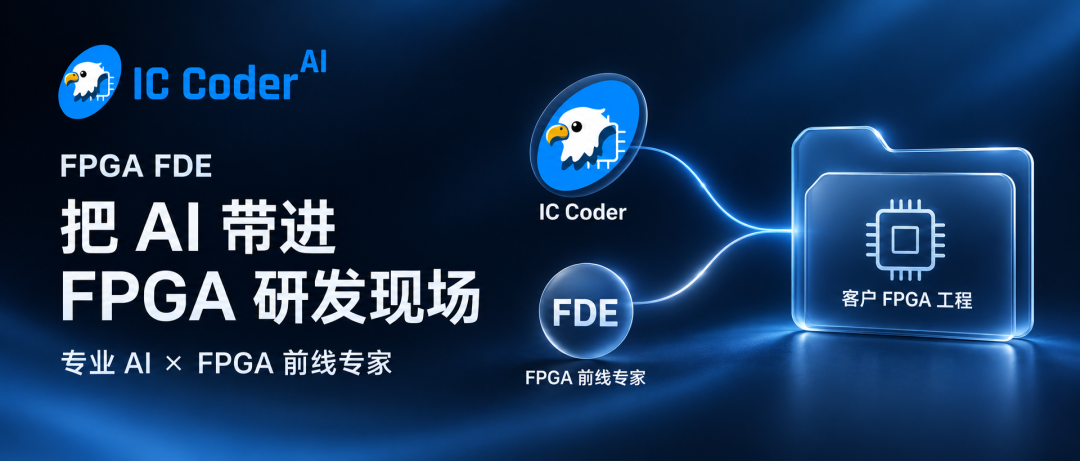
To meet intranet customers' needs for rapid offline validation of AI platform capabilities, IC Coder launches the FPGA FDE service: FPGA frontline experts bring dedicated compute equipment on-site to carry out development and validation around the customer's projects.
Without purchasing a full platform upfront, you can experience complete capabilities in your own engineering environment, obtain project results, and then decide how to use AI going forward.
I. What Is the FPGA FDE Service
1.1 First, Bring the Complete R&D Platform to the Customer
IC Coder has built a complete AI R&D platform covering the closed loop of FPGA design, development, and verification. Centered on FPGA domain-specific large models and an FPGA domain-native Harness, the platform continuously invokes engineering tools and iterates based on results—from requirements understanding and architecture decomposition to RTL development, simulation verification, synthesis implementation, and issue fixing. Analysis, modification, and targeted validation of existing projects can also be directly connected.
Multi-vendor ecosystem and toolchain adaptation help teams advance cross-device code migration and engineering reuse; the enterprise-exclusive knowledge base integrates the customer's existing code, IP, design specifications, and engineering experience into the development process. Technical assets accumulated over years can become the starting point for the next R&D effort.
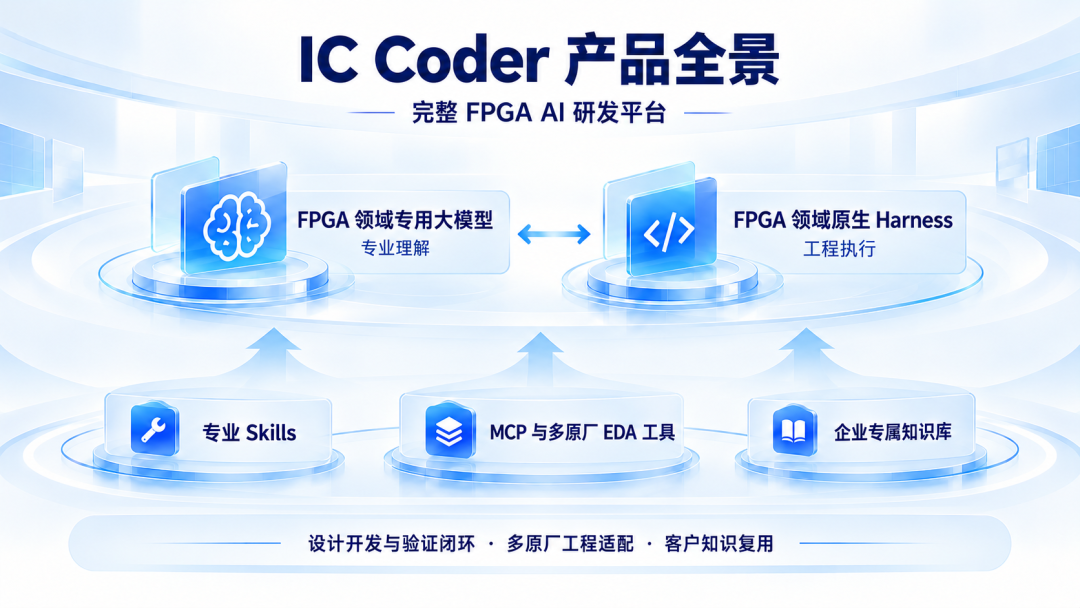
Figure 1 IC Coder Product Overview
1.2 Entering the Customer's Intranet with Compute and Frontline Experts
FPGA FDE is a rapid offline validation service launched by IC Coder for customers with intranet usage requirements. Our engineers bring dedicated compute equipment on-site, deploy the platform in the customer's familiar working environment, and rapidly validate IC Coder's engineering capabilities through historical project reproduction, existing project development, or new project collaboration.
For intranet offline scenarios, the FPGA domain-specific large model is deployed on a dedicated compute server, while the complete IC Coder platform runs on the customer's computer, connecting to models, engineering materials, and EDA tools via the customer's intranet. Model inference and engineering execution are both completed within the intranet, enabling teams with confidentiality requirements and no model compute configured to test complete FPGA AI R&D capabilities with real tasks.
The service positioning is to enable customers to rapidly validate IC Coder's complete capabilities in their intranet environment using their own projects, specifications, and evaluation standards, and to obtain agreed engineering results.
Collaboration can choose a familiar historical project to see how much efficiency can be improved; or directly connect to an ongoing project to solve current development and validation tasks. New projects can also start collaboration from the requirements stage. Everything is executed according to the customer's confidentiality requirements, coding standards, and evaluation criteria, with task scope, functional and performance targets, and result inspection methods clarified at kickoff.
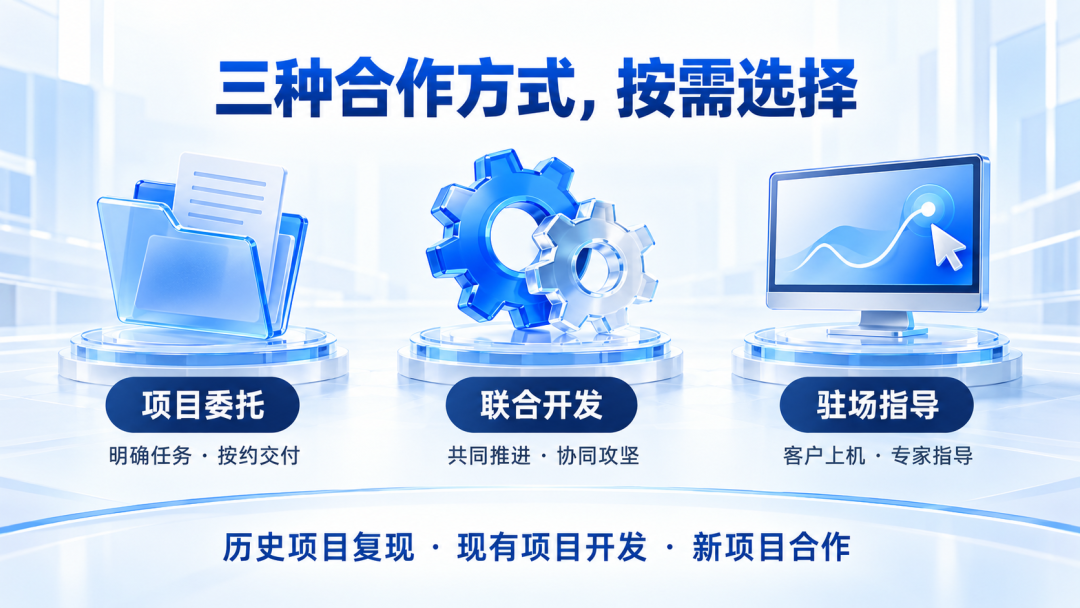
Figure 2 Three collaboration modes available in parallel, suitable for different project stages
Suitable for customers with clear goals who need to supplement development resources or advance urgent tasks. The customer proposes requirements and acceptance targets; our side organizes IC Coder to execute the agreed development and validation tasks, with FPGA frontline experts responsible for solution review, key issue resolution, and quality inspection, delivering source code, project files, and validation materials as agreed.
Suitable for customers who already have R&D teams and wish to accelerate existing projects or tackle key technical challenges. Both parties collaborate around the same project, combining the customer's business understanding with our FPGA and AI engineering capabilities—jointly decomposing tasks, advancing implementation, and analyzing validation results—so that the development process stays continuously aligned with real-world applications.
Suitable for customers who wish to retain AI R&D capabilities within their team. Customer engineers personally operate IC Coder to complete real tasks, with FPGA frontline experts providing on-site guidance, helping the team master methods for requirement expression, context organization, task execution, and result inspection, making a single project practice an experience for independently using the platform in the future.
The three modes are selected according to project needs and can be combined at different stages; customers can define the collaboration scope around current tasks.
III. What FPGA FDE Can Bring to Customers
Historical projects have clear requirements, implementation results, and R&D investment, making them a direct reference for evaluating AI value. Through FDE intranet validation, project tasks are executed entirely by IC Coder; by comparing against historical project investment, efficiency gains can be quickly quantified.
Currently, more than 200 organizations use IC Coder for FPGA R&D, achieving an average R&D efficiency improvement of over 10x. In a large-scale IP project at a leading original manufacturer, the development cycle was shortened from 9 months to 3 months.
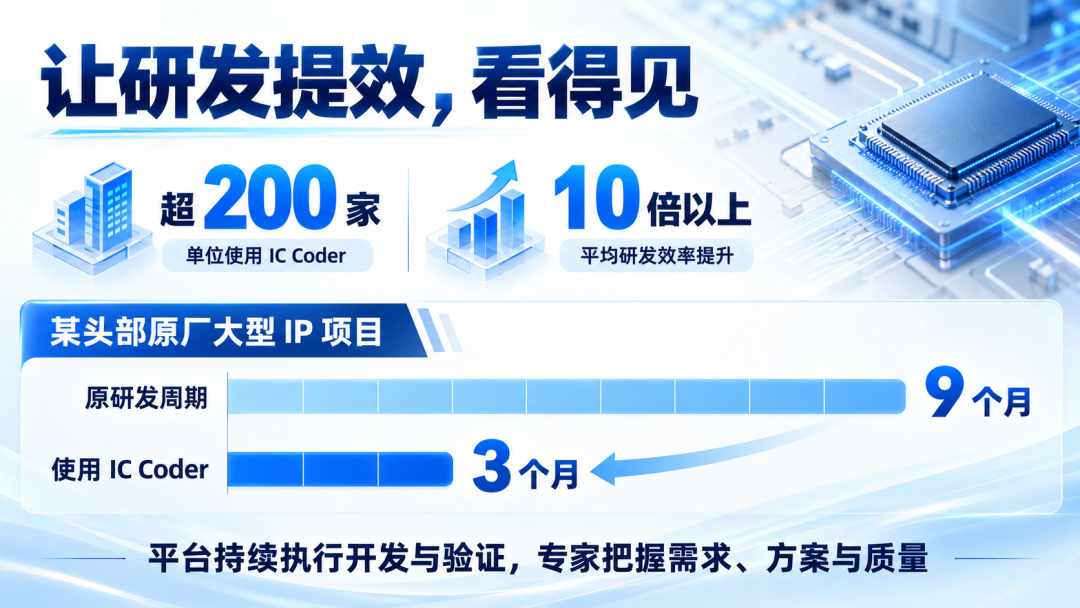
Figure 3 IC Coder platform applications and efficiency improvement case for a large-scale IP project
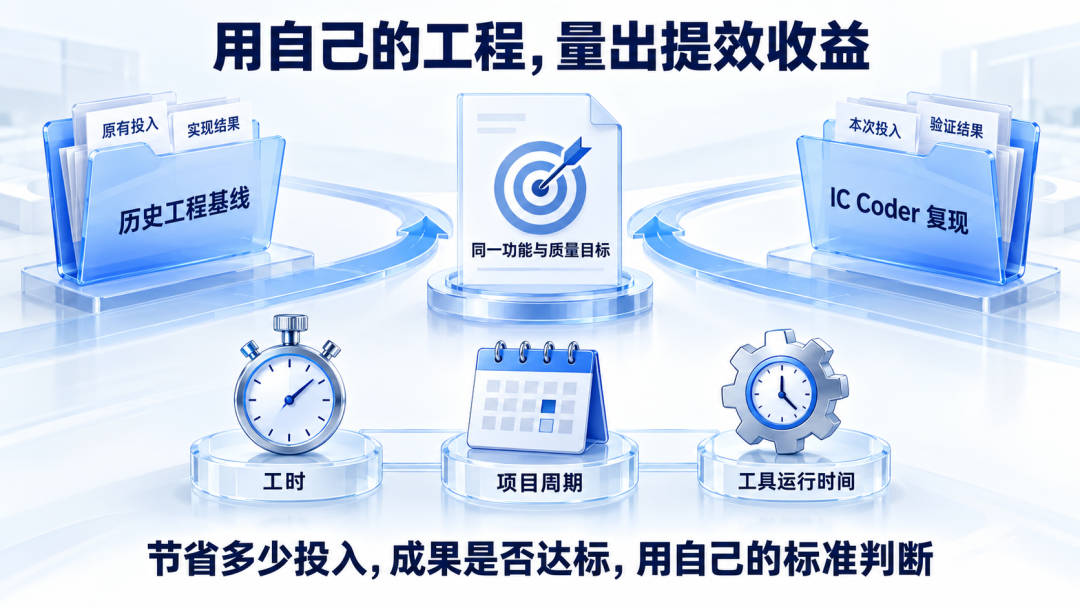
Figure 4 Measuring the customer's own efficiency gains against the same functionality and quality objectives
Through joint development under the FDE model, while accelerating development, it becomes clear which tasks AI can take over, what materials need to be prepared, how to break large projects into AI-executable sub-projects, and how to translate project requirements into prompts that AI can execute quickly......These materials and processes can be accumulated into a set of execution approaches that can be reused in subsequent projects.
3.3 Advancing urgent projects first even without a current platform procurement plan
Even without a current platform procurement plan, urgent development and phased tasks can be advanced through lower-cost project collaboration. Model compute, the full platform, and professional support arrive together with the team, so customers can begin collaboration on current tasks without first purchasing dedicated compute.
Collaboration centers on agreed engineering objectives. Customers may independently use the delivered project results as agreed and, based on actual needs, choose to continue project collaboration, conduct team onboarding, or procure the platform. Current tasks are addressed first, and subsequent procurement is entirely at the customer's discretion.
Figure 5 Collaborate around current tasks first, with subsequent procurement at the customer's discretion
3.4 Using your own intranet and standards to reduce onboarding friction
Core code, design materials, and verification processes remain on the customer's intranet, while model inference and development execution are integrated into the existing work environment. Customers can continue using their own devices, tool versions, coding standards, and evaluation criteria, with frontline experts carrying out deployment and adaptation around these engineering conditions.
Validate directly with your own projects and check against your own standards. By aligning on confidentiality boundaries, device, and tool conditions from the outset, customers can see earlier how the platform performs and where it applies in actual R&D, reducing trial and error and friction during subsequent onboarding.
Figure 6 Models and platform deployed separately, connected to engineering resources through the customer's intranet
3.5 After the project is completed, deliverables and methodology remain
Upon completion of the collaboration, source code, project files, verification materials, and usage documentation are organized and handed over as agreed, enabling customers to take over the results and continue development. Along with the project, validated implementation paths and result verification criteria are also left behind.
Joint development and on-site guidance also bring effective task organization, problem localization, and verification methods into the team. A single collaboration leaves behind engineering results that can be taken over and helps the team develop a sustainable AI R&D methodology. Engineers are gradually freed from repetitive execution and can apply more of their experience to building systems and products.
Figure 7 Handing over engineering results as agreed and accumulating R&D methodology through collaboration
3.6 Frontline experts and professional teams providing support for critical tasks
The IC Coder FPGA FDE team integrates chip engineering, FPGA development, and AI platform capabilities. Our chip lead has over 20 years of chip R&D and mass production experience, with cumulative shipments of related chip products exceeding 100 million units. The judgment developed through long-term engineering practice is applied to requirements decomposition, architecture trade-offs, critical problem analysis, and delivery quality control.
Currently, professional FPGA FDE engineers are stationed in Beijing, Chengdu, Shanghai, Xi'an, Wuhan, and other locations, providing nationwide service coverage and timely response to customer needs. Frontline experts stay close to customers' projects and schedules, while professional teams collaboratively analyze critical issues, providing continuous engineering support for development challenges, verification iterations, and deliverable handover.
Figure 8 Nationwide frontline support and professional team collaboration
Start with the FPGA project you care about most!
To find out how much efficiency AI can bring to your own engineering work, bring a representative historical project; if you have urgent development, verification, or problem-solving tasks, you can also directly state your objectives. We will discuss a suitable FPGA FDE collaboration approach based on engineering conditions and delivery requirements.