Pango PGL22G Development Platform Trial Series (2): SD Card-Based Audio MP3 Player
Many embedded systems require large-capacity storage devices to store data. Currently, commonly used options include USB flash drives, FLASH chips, SD cards, etc. Each has its own advantages. After comprehensive comparison, the SD card is undoubtedly the most suitable for microcontroller systems. It not only offers very large capacity (32GB and above) and supports SPI/SDIO drivers, but also comes in various sizes (standard SD card size, TF card size, etc.) to meet the requirements of different applications. Only a few IO ports are needed to externally expand a storage device of up to 32GB or more, with a wide selection range from tens of MB to tens of GB. Replacement is convenient and programming is simple, making it the first choice for large-capacity external storage in embedded systems.
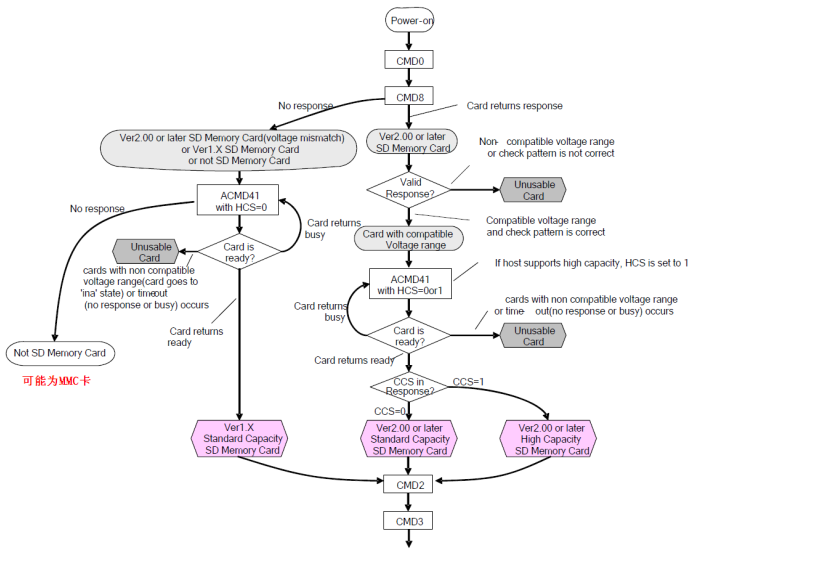
SD card initialization process. To implement SDIO-driven SD cards, the most important step is SD card initialization. As long as the SD card initialization is completed, the remaining (read/write operations) are simple. Therefore, the focus here is on SD card initialization.
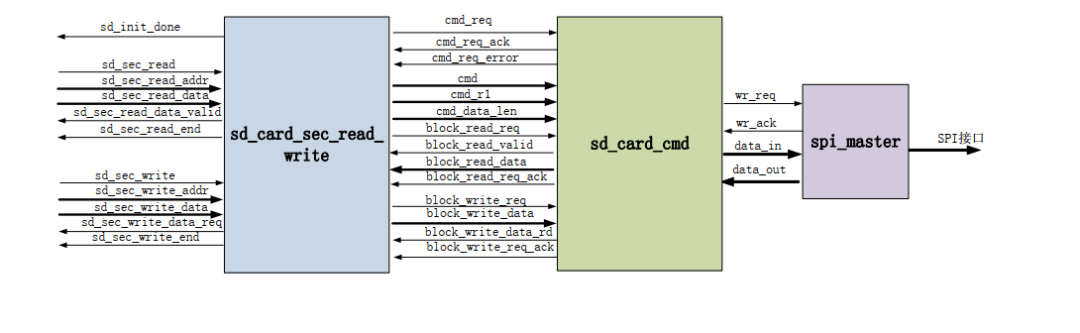
The PGL22G development board is equipped with a Micro SD card socket. The FPGA accesses the Micro SD card through the SPI data bus. The hardware circuit of the SD card socket and FPGA. When the SD card data read/write speed requirement on the PGL22G development board is not high, choosing SPI communication mode can be considered an optimal solution. Because in SPI mode, all data exchange can be completed through four lines. This experiment will introduce how FPGA reads and writes SD cards through the SPI bus. To complete FPGA read/write of SD cards, users need to understand the SD card command protocol.
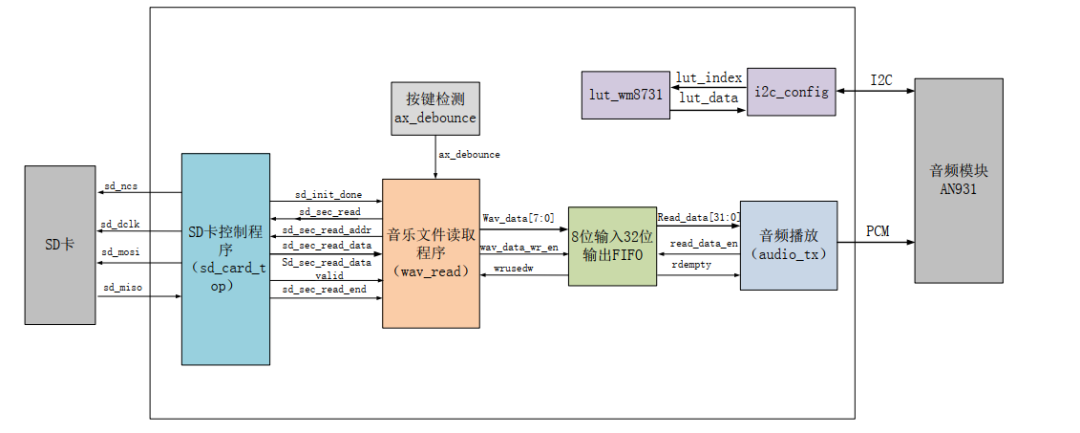
This evaluation involves wav_read searching for WAV files in the SD card, reading out the WAV files and writing them into the FIFO, and finally outputting the data from the FIFO and writing it to the audio module.

Pango PGL22G Development Platform Trial Series (2) — Ethernet Test Project 1
Pango PGL22G Development Platform Trial Series (1) — Initial Experience of Software and Hardware
Pango PGL22G Development Platform Trial Series (8) — Program Password: Program Edition
Pango PGL22G Development Platform Trial Series (7) — Program Password: Theory Edition
Pango PGL22G Development Platform Trial Series (6) — Edge Detection: Synthesis Edition
Pango PGL22G Development Platform Trial Series (5) — Edge Detection: Algorithm Edition
Pango PGL22G Development Platform Trial Series (4) — Edge Detection: UART Communication Edition
Pango PGL22G Development Platform Trial Series (3) — Preliminary Exploration of Key Functions
Pango PGL22G Development Platform Trial Series (2) — Basic Flow Demo
Pango PGL22G Development Platform Trial Series (1) — Software and Devices
Pango PGL22G Development Platform Trial Series (1) — FPGA Parameter Analysis and Comparison
Pango PGL22G Development Platform Trial Series (2) — PDS Software Trial
Pango PGL22G Development Platform Trial Series (3) — Implementing DW8051 MCU on FPGA