Looking at Domestic FPGA Development Through Pango's Award

FPGA is an indispensable key device in the fields of communications, healthcare, consumer electronics, and military. It mainly performs functions such as signal conversion, protocol processing, and prototype verification. Due to high technical difficulty and slow return on investment, despite being invented over 30 years ago, only a handful of companies are still deeply engaged in this field. Currently, leading companies Xilinx and Altera monopolize most of the FPGA market. Amid China-US trade frictions, FPGAs, like high-end CPUs and ADCs, have become "bottleneck" products. In recent years, with the rise of domestic FPGAs, the FPGA field has finally welcomed a Chinese contingent. At present, a domestic landscape has formed with Pango as the leader, and Fudan Microelectronics, Anlogic, Gowin Semiconductor, and Xi'an Intelligence Silicon Technology developing rapidly, achieving widespread adoption in communications, industrial, aerospace, LED screen control, consumer electronics, and other fields.
With the rise of emerging industries such as 5G, artificial intelligence, the Internet of Things, data centers, and intelligent driving, traditional chips can no longer adequately meet application requirements. Flexible and programmable FPGA chips have become an important driving force for future technological development and are of significant strategic importance.
On October 25, the 14th "China Chip" Integrated Circuit Industry Promotion Conference, jointly hosted by the China Center for Information Industry Development, the Qingdao National High-Tech Industrial Development Zone Management Committee, and the China Semiconductor Industry Association, grandly opened in Qingdao. Pango's independently developed Titan series high-end FPGA product PGT180H stood out from 187 participating chips and successfully won the 2019 "China Chip · Outstanding Market Performance Product" award, becoming the only FPGA product to win at this year's "China Chip" awards.
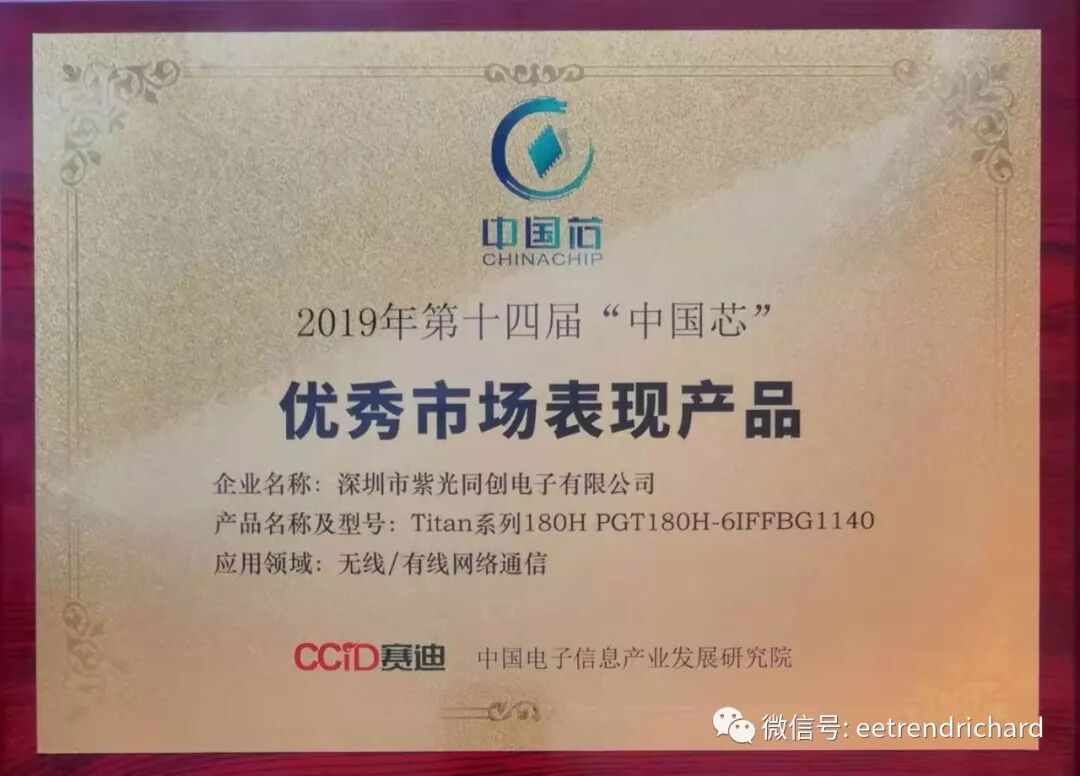
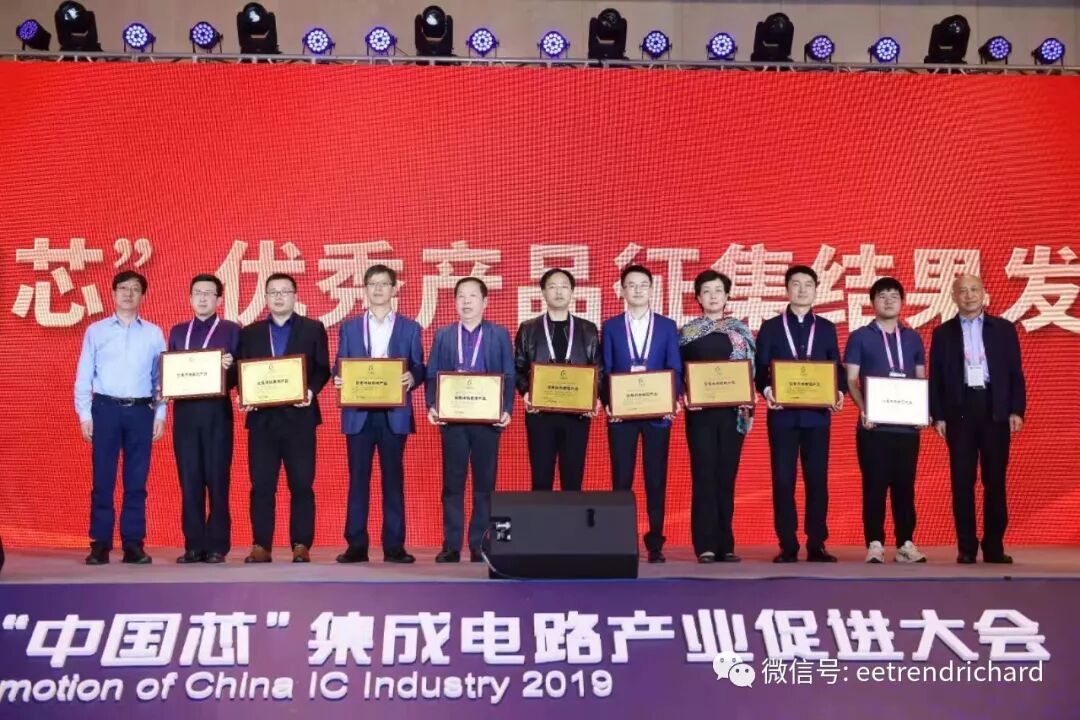
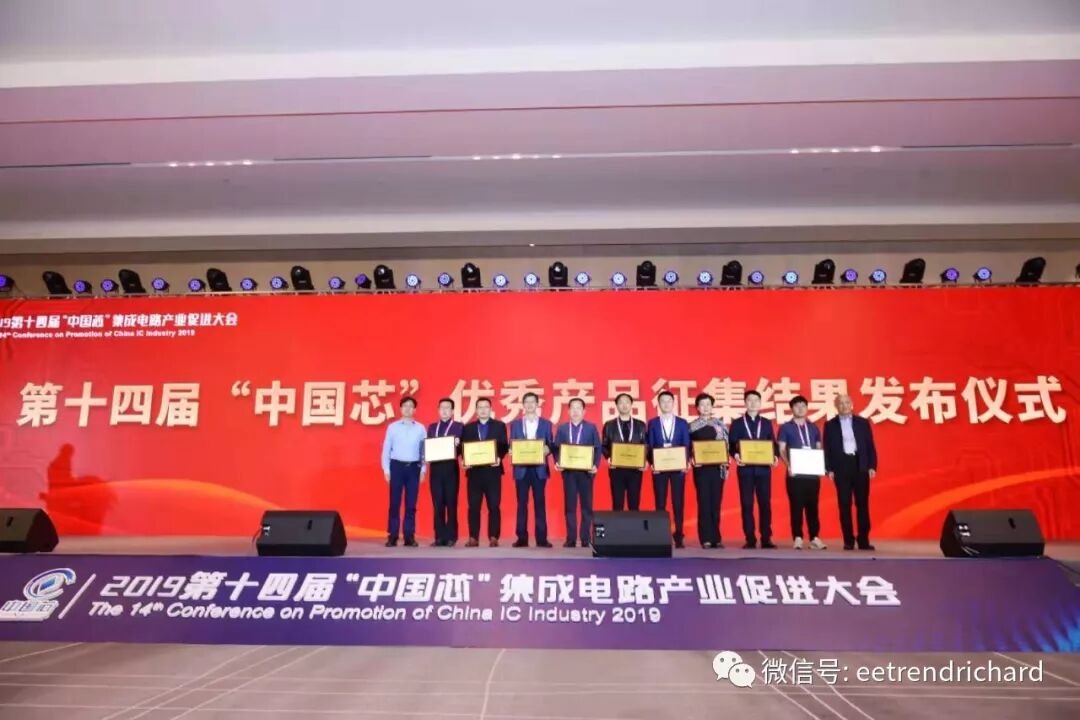
As a leading Chinese FPGA manufacturer, Pango has always been committed to the localization of core chips and devices. In recent years, it has successively launched Titan series high-performance FPGA products using 40nm process, Logos series high-cost-performance FPGA products using 40nm process, and Compact series CPLD products using 55nm process, covering high-end, mid-range, and low-end market application requirements.
"Building the industry through application, prospering the industry through application" was the theme of this Integrated Circuit Promotion Conference, and it accurately pointed out the dilemma of the domestic integrated circuit industry. In the context of China-US trade competition and domestic substitution, only when domestic chips gain recognition from the application side can product iteration be accelerated and the competitiveness of domestic chips be enhanced. The award-winning product PGT180H from Pango is the most high-end product among domestic FPGA manufacturers. It adopts an independently owned architecture and advanced process, with up to 20 million gates, a maximum system frequency of 500MHz, SERDES speed of 6.25Gbps, and support for 10-gigabit and gigabit network transmission interfaces. It is widely used in communications, video, industrial control, and many other application fields, filling the domestic gap in independently owned 10-million-gate-level high-performance FPGAs.
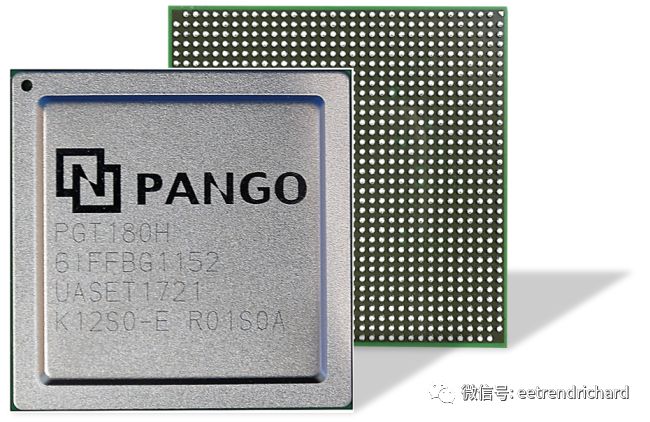
To date, Pango's independently developed Titan series high-end FPGA product PGT180H has been supplied in volume to multiple leading domestic communications equipment manufacturers. In 2019, sales of this single FPGA model reached nearly 100 million yuan, successfully breaking the long-term monopoly of foreign giants in terminal applications. At present, China's 5G communications industry has all key factors in place across spectrum, chips, terminals, and operators, with its overall level in the international first tier. However, there are still shortcomings in core chips, components, and materials such as FPGA chips, RF/analog chips, memory, CIS, sensors, optical chips, and high-frequency high-speed materials. FPGA chips in particular still basically rely on imports, posing severe challenges to the development of China's 5G communications industry. In the communications field, Pango's PGT180H is mainly used in network access and transmission equipment for interface conversion, packet processing, and other application scenarios. Its product quality, stability, and service level have all gained market recognition, achieving domestic substitution of FPGA products of equivalent scale and alleviating the "bottleneck" dilemma imposed by foreign manufacturers. Especially in the context of the China-US trade war, it resolved the life-and-death problem in product development for leading domestic communications equipment manufacturers and safeguarded the R&D and production of China's 5G and other communications equipment.
In the FPGA industry, international giants have already entered the 7nm process node, with logic capacities reaching 400 million gates, primarily targeting high-end applications such as artificial intelligence and data centers. In contrast, domestic FPGA companies, due to various reasons including technology and talent, have found large-scale, high-performance FPGA development to be virtually uncharted territory. As of now, domestic FPGA companies still mainly rely on 40nm and 55nm process nodes, with product logic capacities within 200K, leaving a significant gap compared to international giants. After achieving a breakthrough with China's first 10-million-gate-level high-performance FPGA product, Pango's 28nm advanced-process 10-million-gate-level high-performance FPGA test chip has been successfully taped out, and engineering samples are about to be released. This makes Pango the first to bring domestically owned FPGA intellectual property into a new-generation process node, providing customers with higher-performance and lower-power FPGA solutions.
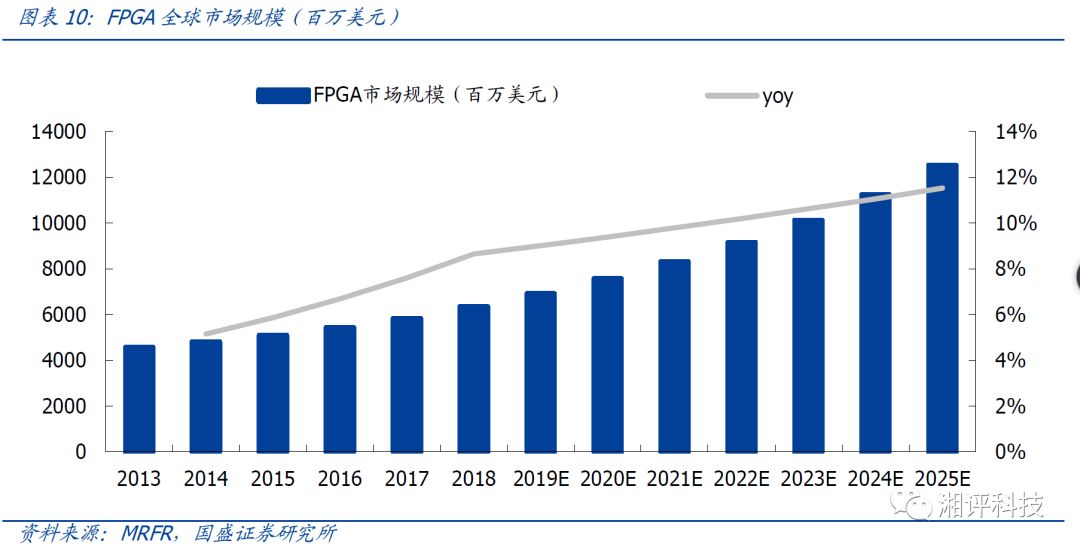
According to MRFR statistics and forecasts, the global FPGA market was valued at US$4.563 billion in 2013 and grew slowly to US$6.335 billion by 2018. However, with the advancement of the 5G era and the pace of AI development, MRFR predicts that the FPGA market is expected to reach approximately US$12.521 billion by 2025.
Currently, the gap between Chinese vendors and international giants in the FPGA niche segment is larger than in other fields. The biggest reason is that the technical threshold for FPGA is extremely high, with core technologies held by only a very small number of companies. According to statistics, Xilinx and Altera currently hold more than 6,000 patents, creating nearly insurmountable technical barriers for latecomers to the industry.
While Pango has been advancing rapidly, other domestic FPGA vendors have also made great strides. Fudan Microelectronics has developed high-end FPGAs with performance comparable to Xilinx Virtex-7, and Anlogic, Zhiduojing, and Gowin have also achieved initial success.
In June this year, Shanghai Anlogic completed its Series D capital increase. In this round, existing shareholders Huada Semiconductor, CITIC Capital, and the company's founding team exercised their preemptive rights, while new shareholders introduced include the National Integrated Circuit Industry Investment Fund Co., Ltd. (hereinafter referred to as the "Big Fund"), Shenzhen Capital Group Co., Ltd., and Suzhou Houzai Growth Investment Management Partnership (Limited Partnership), among others. It is reported that this round of financing will be used for Shanghai Anlogic's R&D of 28nm (and 12nm) 10-million-gate-level and 50-million-gate-level FPGAs and SoC FPGAs. The new products will be mainly applied in communications, industrial control, display, consumer electronics, and artificial intelligence fields, providing global semiconductor companies with high-performance, low-cost, and high-reliability quality FPGAs.
Xi'an Zhiduojing has currently achieved mass production of 55nm and 40nm mid-density FPGAs and has launched integrated solution products with embedded Flash, SDRAM, and other features. As of 2018, it has shipped 2KK units in volume. At this year's Mobile World Congress Shanghai (hereinafter referred to as MWC Shanghai), Xi'an Zhiduojing exhibited its Sealion 2000 series FPGA chips, which have already been successfully commercialized in multiple application fields. At this exhibition, Zhiduojing was invited by China Mobile Research Institute to appear alongside China Mobile's overall 5G small cell solution. As an important chip provider in the 5G small cell solution, Zhiduojing joined many peers and guests at this MWC event to experience up close the rich applications brought by the arrival of the 5G era, covering multiple fields such as transportation, entertainment, healthcare, and manufacturing.
China Mobile exhibition area, domestic chip exhibition area - "Zhiduojing Microelectronics"
In 2014, Gowin Semiconductor was founded in Foshan and later moved to Guangzhou. Its core R&D personnel have an average of more than 15 years of experience in FPGA software and hardware technology development. Its CEO, Zhu Jinghui, graduated from Tsinghua University and was responsible for technology R&D at Lattice from 1996 to 2011, during which he experienced seven generations of FPGA product development and obtained 11 U.S. patents and 5 Chinese patents. Its SVP, Song Ning, previously served as a senior engineer at Lattice and Cadence and is responsible for Gowin Semiconductor's full-flow FPGA software development, with unique experience in the synchronous development of FPGA architecture, hardware design, and software R&D.
In terms of product development, Gowin Semiconductor mass-produced China's first industrialized 55nm 4-million-gate mid-density FPGA chip in 2015 and opened its development software for download; in the first quarter of 2016, it successfully launched China's first 55nm embedded Flash+SRAM non-volatile FPGA chip; in 2017, the GW1N-4 and GW1N-1 in the LittleBee family and the GW2A series FPGA products in the Arora family began volume shipments; in 2018, Gowin announced the successful development of the GW3AT-100, China's first 28nm mid-to-high-density FPGA, manufactured by TSMC; in 2019, Gowin announced the launch of a security FPGA.
In August this year, Guangdong Gowin Semiconductor Corporation announced the signing of Marubun Corporation as its Japanese distributor, bringing its FPGAs into the Japanese market and becoming the first domestic FPGA company to introduce Chinese FPGAs into the Japanese market.
Shanghai AGM Microelectronics Co., Ltd. (AGM) was founded in 2012 and is a leading domestic fabless semiconductor IC design company based on programmable logic technology that provides SoC chips for application markets. It was founded by a team from a well-known programmable logic SoC company in Silicon Valley, USA, together with a seasoned domestic engineering team. AGM currently focuses primarily on small- and medium-scale FPGAs/CPLDs.
In June 2016, Capital Microelectronics split due to funding and restructuring issues. However, through the persistence and efforts of Wang Haili and several veteran employees, the company secured investment and undertook a second startup, establishing Gowin Microelectronics. In addition to continuing to sell its existing FPGA chips, the company also develops AiPGA chips for emerging applications such as artificial intelligence, heterogeneous computing HPA chips, and embedded programmable eFPGA IP cores. Gowin Microelectronics is now on track; in 2018, its sales orders exceeded 10 million, and the company positions itself as China's leading supplier of domestic FPGAs and next-generation heterogeneous programmable computing chips. The key to the company's future development remains its ability to provide products with market competitiveness.
Overall, relying on the vast domestic application market, domestic FPGA vendors will all find their own room for development. However, in addition to improving product performance and reliability, domestic FPGA vendors also need to shore up shortcomings in tool development and ecosystem building. "The road ahead is long and arduous." Because domestic FPGA companies started relatively late and are still small in scale, the future development of domestic FPGAs has a long way to go and will still require time.
Therefore, Pango's receipt of the China Core Excellent Market Performance Product Award this time is of great significance. Bao Chaowei, general manager of Pango's Marketing Center, said that the Excellent Market Performance Award is highly valuable and must be based on large market sales. Pango's winning of this award is also of milestone significance. In the future, Pango will continue to push into high-end FPGAs. Pango has already started R&D on 14nm billion-gate ultra-high-speed SERDES high-end FPGAs, and will next carry out R&D on various key technologies and key functional modules in succession, so as to completely break the monopoly of foreign vendors in high-end applications, safeguard domestic high-end applications such as next-generation communication technology, data centers, and cloud computing, and conquer the last piece of uncultivated land in China's FPGA industry!