AI Data Centers Move Toward 800V DC Rack Power: Microchip and Navitas Partner on Power Transition

AI Data Centers Move Toward 800V DC Rack Power Architecture: Microchip and Navitas Partner to Drive Power Transition
— The collaboration introduces an 800V-to-6V reference design integrating digital power control and hardware-level security capabilities, accelerating development of high-efficiency Open Compute Project (OCP) rack power solutions
As AI data centers continue to scale to support high-power GPU clusters, the industry is progressively shifting toward 800V DC rack power architectures to improve power distribution efficiency, increase power density, and support next-generation server designs. To accelerate this transition, Microchip Technology and Navitas Semiconductor have jointly introduced an 800V DC-to-6V DC reference design targeting AI data center rack power applications.
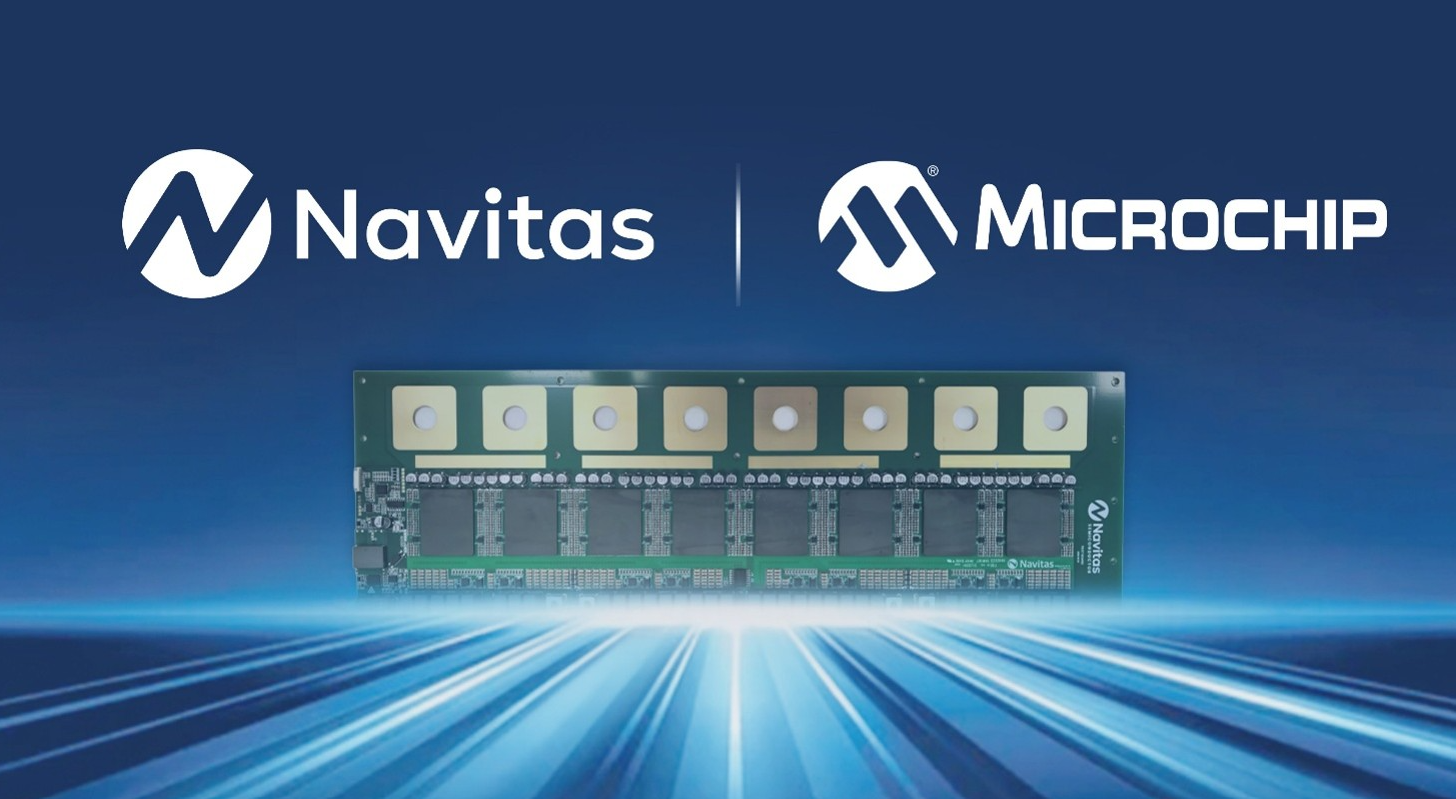
The platform integrates Microchip's digital power control and security technologies with Navitas' GaNFast™ gallium nitride (GaN) power devices, providing developers with a deployable path to high-efficiency power conversion that complies with the Open Compute Project (OCP) 800V DC standard. The solution is accompanied by reference hardware, software, and design documentation, helping to reduce design risk, shorten development cycles, and accelerate deployment of next-generation AI infrastructure.
"AI infrastructure optimization is driving one of the most significant power architecture shifts the data center industry has seen in decades," said Joe Thomsen, Corporate Vice President of Microchip's Digital Signal Controller business unit. "As the ecosystem evolves toward higher-voltage rack power systems, developers need validated control and security solutions to reduce implementation risk. Our collaboration with Navitas combines digital control, hardware security, and advanced GaN power conversion technology to help customers bring 800V rack power systems to market faster."
The reference platform is built around Microchip's dsPIC33AK digital signal controllers (DSCs) and TA100 CryptoAuthentication™ security ICs, paired with Navitas GaNFast field-effect transistors. The dsPIC33AK provides deterministic digital power control for high-frequency, high-efficiency DC/DC conversion, while the TA100 establishes a hardware root of trust for device identity authentication, secure boot, and secure firmware updates. Together, these technologies form the precision control and security foundation required for connected OCP power designs. The dsPIC33AK256MPS306 family features a 200 MHz 32-bit core with a double-precision floating-point unit (FPU), multiple 78-picosecond high-resolution pulse-width modulators (PWMs), and 12-bit analog-to-digital converters (ADCs) with sample rates up to 40 MSPS. The devices incorporate a post-quantum cryptography algorithm library recommended by Commercial National Security Algorithm Suite 2.0 (CNSA Suite 2.0), as well as hardware-accelerated cryptographic modules, meeting the requirements of connected real-time control designs.
The power distribution board (PDB) employs 16 NV6034 (650V, 17 milliohm) GaNFast field-effect transistors on the primary side, forming a stacked half-bridge topology. The DFN 8×8 dual-side cooling package reduces thermal resistance, fully leveraging GaN device performance to maintain excellent efficiency under continuous high-power operation. The power distribution board targets a full-load peak efficiency of 96%, a switching frequency of 1 MHz, and a power density of 2,100 W/in³.
The product is approximately 20% thinner than a smartphone, and its ultra-low-profile design enables close integration with GPU boards, maximizing transient response performance and improving power distribution efficiency. Navitas' system-level solution translates GaN technology advances into quantifiable improvements in efficiency, power density, transient response performance, and total cost of ownership. The 800V DC direct-to-6V DC architecture consolidates the conventional two-stage conversion from 800V DC to 50V DC and then from 50V DC to 6V DC into a single converter, achieving higher end-to-end conversion efficiency.
Vipin Bothra, Vice President of Global Solutions Marketing at Navitas Semiconductor, said: "As AI infrastructure continues to scale to support computing platforms with ever-rising compute demands, Navitas' GaNFast technology is a key enabler of higher power density, better energy efficiency and system performance. By combining Navitas' leadership in power semiconductors with Microchip's digital control expertise, this collaboration will accelerate the delivery of advanced power solutions that meet the evolving needs of next-generation AI data centers."
Hardware-level security is provided by the Microchip TA100 CryptoAuthentication security IC, enabling developers to establish a trusted foundation for system authentication and protection without developing related functions from scratch. The TA100 device supports code authentication, including secure boot, message authentication code (MAC) generation, trusted firmware upgrade, and supports Transport Layer Security (TLS) and other key management protocols as well as other root-of-trust-based security operations.
Microchip and Navitas jointly launched this reference design to provide a platform for developing high-voltage, high-power, compact AI data center rack power systems. The design comes with a reference board, software and technical documentation, enabling developers to leverage these resources to evaluate and accelerate the deployment of 800V DC power conversion systems for AI data centers.
About Microchip Technology Inc.
Microchip Technology Inc. is a leading provider of a rich portfolio of semiconductor products, dedicated to making innovative designs easier through complete system-level solutions and helping customers address the key challenges of applying emerging technologies to mature markets. The company offers easy-to-use development tools and a broad product portfolio to support customers throughout the design process from concept to final implementation. Headquartered in Chandler, Arizona, USA, Microchip continues to deliver solutions for industrial, automotive, consumer, aerospace and defense, communications and computing markets through outstanding technical support. For more information, visit the company website at www.microchip.com.
About Navitas Semiconductor
Navitas Semiconductor (Nasdaq: NVTS) is a leader in next-generation power semiconductors, specializing in gallium nitride (GaN) IC devices and high-voltage silicon carbide (SiC) technology. Navitas continues to innovate in AI infrastructure, covering grid and energy infrastructure, AI data centers, high-performance computing and industrial electrification. The company has accumulated more than 30 years of wide-bandgap technology R&D experience. Its GaNFast™ power ICs integrate GaN power units, drive, control, sensing and protection functions to deliver faster power delivery, higher system power density and better energy efficiency. GeneSiC™ high-voltage SiC devices use patented trench-assisted planar technology to provide industry-leading voltage capability, conversion efficiency and reliability for medium-voltage grid and infrastructure applications. Navitas holds more than 300 granted or pending patents and is the world's first semiconductor company to receive CarbonNeutral® certification.
Note: The Microchip name and logo combination and the Microchip logo are registered trademarks of Microchip Technology Incorporated in the U.S.A. and other countries or regions. CryptoAuthentication is a trademark of Microchip Technology Inc. in the U.S.A. and other countries or regions. All other trademarks mentioned herein are the property of their respective holders.
This press release contains "forward-looking statements" within the meaning of the U.S. Private Securities Litigation Reform Act of 1995 and Section 21E of the U.S. Securities Exchange Act of 1934, as amended. Forward-looking statements are intended to predict or describe future events, trends or other similar matters and are not statements of historical fact. Forward-looking statements are not predictions of actual future performance.
Actual events and circumstances are difficult to predict, or even impossible to predict, and may differ from the relevant assumptions and expectations. The risks facing Microchip are disclosed in its most recent annual report (Form 10-K) and updated in its most recent quarterly report (Form 10-Q) and other filings with the U.S. Securities and Exchange Commission (SEC). For Navitas, the relevant risk factors are disclosed in the "Risk Factors" section of its most recent annual report (Form 10-K) and updated in its most recent quarterly report (Form 10-Q) and other filings with the SEC.
If any of the foregoing risks occur, or the relevant assumptions underlying the forward-looking statements prove to be incorrect, actual results may differ materially from those reflected in these forward-looking statements.
Forward-looking statements may be identified by the use of the following words or similar expressions, including but not limited to: "we expect," "are expected to be," "estimate," "plan," "project," "forecast," "intend," "anticipate," "believe," "seek," "will," "targets," "designed to," "help accelerate," and the like.
Forward-looking statements are made based on estimates and projections of financial and performance metrics, expectations regarding market opportunities, and current indications of customer interest, all of which are based on various assumptions. All such statements are based on the current expectations of Navitas and Microchip management.
Neither Microchip nor Navitas undertakes any obligation to update forward-looking statements as a result of events or circumstances occurring after the date of this press release.