AMD Launches 6th Gen AMD EPYC Embedded Processors, Extending CPU Leadership
AMD Launches 6th Gen AMD EPYC Embedded Processors, Extending CPU Leadership AMD EPYC Embedded 9006 Series SP7 CPUs deliver leadership performance with up to 256 cores, scalable PCIe Gen 6 and CXL 3.1 connectivity, advanced security and seven-year product longevity.
Please read through and acknowledge the Terms & Conditions before downloading.
By downloading and incorporating the AMD Trademarks or AMD Logos and/or images provided herein (collectively, the “AMD Mark(s)”), you are accepting the Terms and Conditions and committing you and your company to the Terms and Conditions. Once the Terms and Conditions are accepted, AMD uses Cookies to enable the user to bypass this screen when downloading AMD brand assets in the future.
The AMD Marks are owned exclusively by Advanced Micro Devices, Inc. ("AMD"), protected under relevant trademark and copyright laws around the world, and are provided on an “as is” basis without warranty of any kind, express or implied, for use subject to the terms of this license (“License”). AMD hereby grants you ("Licensee" or “You” or “Your”) limited permission to use the AMD Mark(s) solely in connection with the advertising, marketing, promotion, and sale of Licensee products that include an AMD CPU, GPU, APU, or FPGA (each an “AMD Processor”) and in accordance with the AMD Corporate and Product Branding Guidelines, which may be modified by AMD from time to time. You agree to ensure that You are in possession of the latest, updated version.
This grant does not extend to use of AMD Mark(s) on Licensee product packaging or use of AMD Mark(s) on any goods that do not contain an AMD Processor. AMD shall remain the exclusive owner of all rights in the AMD Mark(s), and this License does not grant any other rights with respect to AMD’s Mark(s) trademarks or copyright. You agree that You will not, nor will you help others, contest, attack, or dispute AMD’s rights in the AMD Mark(s). The AMD Mark(s) must be used only in a positive manner and shall not be used in any way that may, in AMD’s sole judgement, disparage AMD’s reputation.
You agree not to use the AMD Mark(s) in a manner to suggest AMD’s endorsement or sponsorship of your goods or services, or in any way that may create confusion as to the source of the goods, and Licensee’s company name, logo or product name shall appear on any products or related materials where an AMD Mark(s) is used. This license may be terminated by AMD at any time, and failure to comply with these terms will result in automatic termination of this License.
Sometimes AMD acquires the right(s) to certain image(s) and includes such image(s) within AMD system(s) (“Licensed Images”). You agree to refrain from using Licensed Images for any reason outside of those directly related to your reason for accessing AMD system(s) contemplated under these Terms and Conditions. Additionally, you agree to comply with all limitation(s) on Licensed Images that are communicated to you by AMD, including but not limited to limitation(s) conveyed to you via notes in a file containing the Licensed Images.
If You encounter any non-public information related to AMD (“Confidential Information”) while accessing AMD system(s), You agree to (a) reasonably protect and not disclose any Confidential Information to any third party(ies) without AMD’s written permission; and (b) refrain from using Confidential Information in ways not relating to your access of AMD system(s).
If it is determined by AMD – in its sole opinion - that You have violated these Terms and Conditions or have otherwise misused Confidential Information, Your access to AMD system(s) may be revoked immediately and without notice.
If you have any questions regarding the terms and conditions of this Agreement, please contact the AMD Law Department at amd.trademarks@amd.com .
What’s the News?AMD announced the AMD EPYC™ Embedded 9006 Series SP7 CPUs, expanding its x86 processor portfolio optimized for embedded customer requirements and deployments.Advanced by the high-performance “Zen 6” core architecture, AMD EPYC Embedded 9006 CPUs combine up to 256 cores, scalable PCIe® Gen 6 and CXL® 3.1 connectivity, and advanced security from secure boot through runtime.With a throughput increase of up to 1.8x compared with the previous generation 5th Gen AMD EPYC™ 9005 Series processors, 1 they provide the leadership compute and high-speed connectivity needed to scale throughput and handle increasingly demanding workloads in semiconductor automated test equipment (ATE), enterprise storage and network firewall applications.
Seven-year product longevity, support for post-quantum cryptography for firmware signing, and ongoing security updates simplify maintenance and long-term support for mission-critical embedded applications.
Why It Matters? As AI infrastructure expands and data volumes grow, semiconductor ATE needs to validate memory and I/O devices faster, firewalls need to process and secure more network traffic, and storage controllers need to move and process more data. AMD EPYC Embedded 9006 processors deliver the high throughput, memory bandwidth and I/O performance required to meet these growing application demands.
What’s the Role of AMD?
What Do the New CPUs Support? EPYC Embedded 9006 CPUs help power semiconductor-ATE systems that enable production-scale validation of new memory and I/O devices. The CPUs act as the control and orchestration engine, managing memory and storage test workloads and interfaces for high-speed DDR5 RDIMM and emerging MRDIMM technology, as well as switches and devices supporting PCIe Gen 6 and CXL 3.1. They also provide the compute scalability to run more tests in parallel.
As expanding AI infrastructure increases network traffic, high-end firewalls supporting 400G/800G networks face growing throughput and security-processing requirements. EPYC Embedded 9006 CPUs provide the control-plane engine to manage growing security policies and network sessions, to process new flows and traffic exceptions, and to deliver the throughput for security processing and faster connectivity to data-plane accelerators. They offer customers up to 1.3x higher firewall throughput compared with the previous generation. 2
AI data growth is transforming enterprise storage requirements. AMD EPYC Embedded 9006 CPUs power non-volatile memory express (NVM Express®) connectivity, data movement and storage processing to manage NVMe devices. They accelerate data-intensive storage services such as compression, caching and RAID systems, delivering an increase over the previous generation of up to 1.5x on the intelligent storage acceleration library (ISA-L) benchmark 3 that measures how quickly a processor performs specific functions used in storage services.
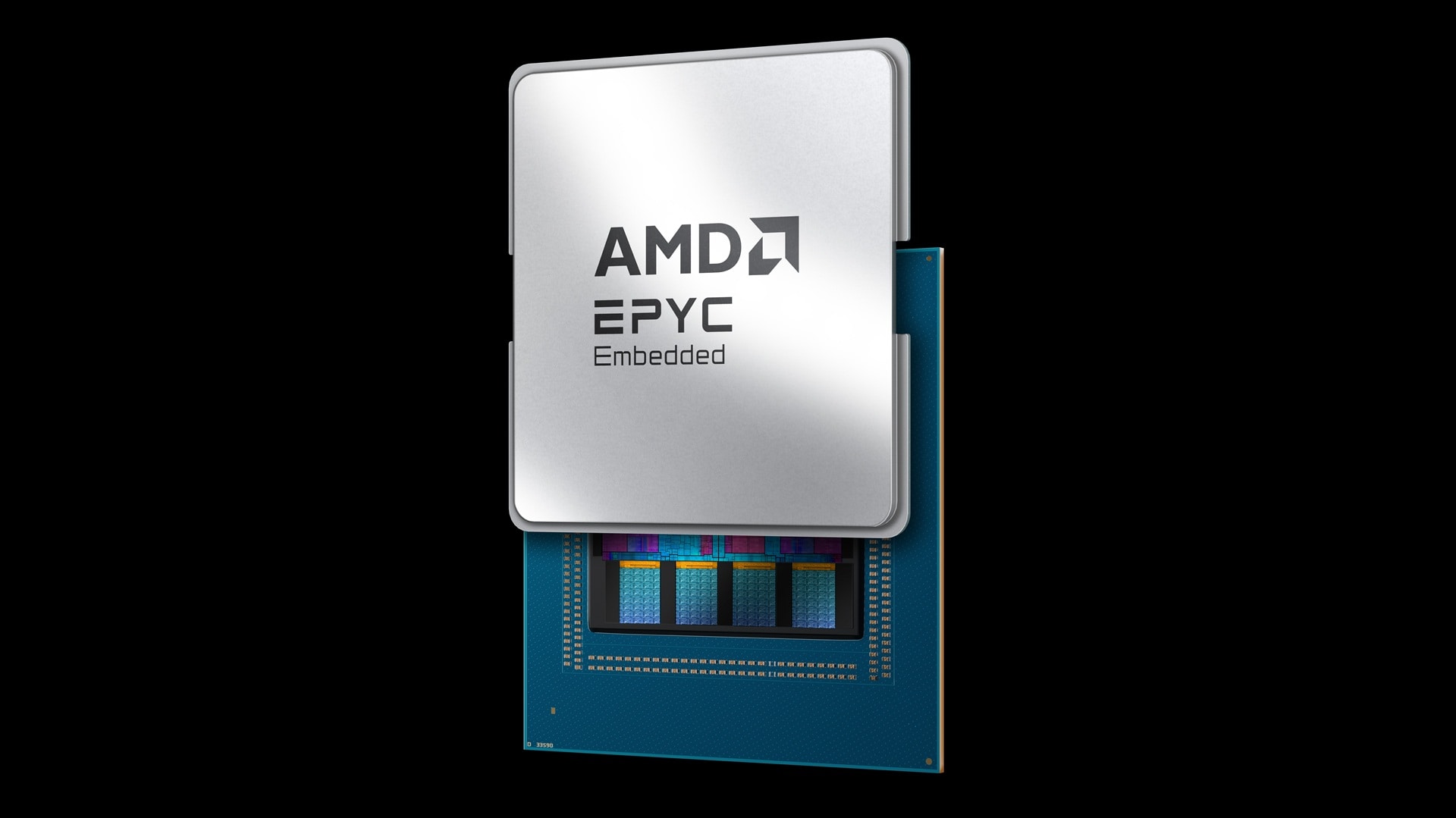
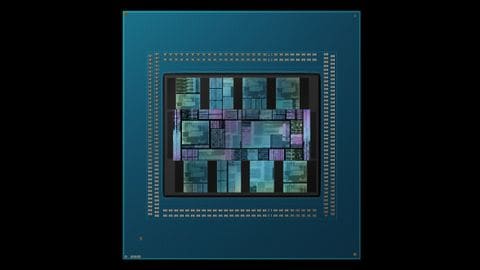
AMD launched its AMD EPYC Embedded 9006 Series SP7 processors in 2026, expanding its x86 processor portfolio optimized for embedded customer requirements. The CPUs deliver leadership performance with up to 256 cores, scalable PCIe Gen 6 and CXL 3.1 connectivity, advanced security and seven-year product longevity. (Credit: AMD)
Please read through and acknowledge the Terms & Conditions
Please accept the terms above before downloading.
What Do EPYC Embedded 9006 CPUs Deliver?The processors offer up to 256 cores and 512 threads and up to a 1.8x throughput improvement compared with the previous generation.1 To help reduce bottlenecks in demanding workloads, they deliver up to 1.5x higher I/O bandwidth 4 and up to 2.7x higher memory bandwidth 5 compared with the prior generation.Sixteen DDR5 memory channels support RDIMM speeds up to 8,000 megatransfers per second (MT/s) and MRDIMM speeds up to 12,800 MT/s.Up to 96 PCIe Gen 6 lanes operate at 64 gigatransfers per second, while flexible PCIe Gen 6 and CXL 3.1 support high-speed connectivity with compatible networking, storage, accelerators, test equipment and memory expansion.What Makes EPYC Embedded 9006 Series Unique?The processors provide seven-year product longevity for long-term embedded deployments.
Ongoing embedded-focused firmware updates and software support help simplify maintenance for mission-critical embedded applications and systems.Building on the EPYC 9006 server CPU architecture, they also provide enterprise-class reliability, availability and serviceability features that help teams maintain embedded infrastructure, with telemetry and predictive failure analysis available through supported platform implementations.
Advanced security is delivered with dedicated security engines that provide complementary layers of protection, from establishing trust at boot to securing runtime operation and verifying platform identity and integrity. Each engine uses separate resources to reduce attack exposure and strengthen resilience:
AMD root of trust (ART) establishes the initial immutable silicon root of trust and enables secure boot by creating a chain of trust to authenticate firmware components as the system boots. ART also supports post-cryptography for firmware signing, helping to protect the platform against future quantum threats, along with hardware protections against physical and side-channel attacks.
AMD Security Processor (ASP) acts as the boot orchestrator and provides key security services during operation, including a trusted execution environment. It also provides secure debug capabilities for authorized diagnostics and troubleshooting. For virtualized environments, the ASP also manages the keys used to protect VM memory.
Caliptra, an open-source vendor-agnostic silicon root of trust, is used for device identity and attestation, and allows a remote entity to verify a device is genuine and that the expected BIOS and firmware are running on the platform.
What Are Customers Saying?
“As memory and I/O technologies continue to advance, our manufacturing test environment needs to keep pace with increasing performance and bandwidth requirements. AMD EPYC™ Embedded 9006 Series SP7 CPUs integrated with Samsung DDR5 RDIMM and MRDIMM, PCIe Gen 6 enabled PM1763 SSD, and CXL 3.2 CMM-D MD310 provide the scalable compute, memory bandwidth and high-speed I/O capabilities. We look forward to working with AMD to bring these capabilities into our manufacturing test infrastructure."
– Jangseok (JS) Choi, vice president, Memory Product Planning Team, Samsung Electronics
“Our goal is to give customers a platform they can build on with confidence. Powered by AMD EPYC Embedded 9006 Series SP7 CPUs, Lanner’s NCA-6145 is designed to take on the growing demands of networking and security. Our collaboration with AMD brings together their processor innovation and our experience building network appliances. What excites me most is seeing what our customers will build with it, from tackling today’s toughest challenges to creating new possibilities for tomorrow’s networks.”
– Fred Chang, associate vice president, Product Planning Division, Lanner
“AMD EPYC Embedded 9006 processors are instrumental to Portwell’s next-generation test-and-measurement platforms, delivering the massive memory capacity and extreme bandwidth needed for ultra-deep waveform buffering. Paired with high-speed PCIe Gen 6 connectivity, these processors enable seamless, real-time data ingestion from multichannel acquisition front ends, providing the deterministic performance and reliability essential for our customers’ mission-critical precision instrumentation.”
– Oskar Wu, senior vice president, Portwell, Inc.
“AMD EPYC Embedded 9006 SP7 Series introduces PCIe Gen 6 and CXL 3.1 I/O connectivity, delivering 96 lanes at 64 GT/s from a single socket, enabling a single test system to validate large numbers of Gen 6 SSDs in parallel, at full speed. That is exactly what high-end storage testing demands. Advanced by ‘Zen 6’ core architecture with up to 256 cores, these processors deliver up to 1.5x higher I/O bandwidth compared to the prior generation, with every SSD under test using dedicated compute and data resources, significantly shortening test cycles. Together with AMD, we’re helping customers bring next-generation PCIe Gen 6 storage devices to market faster with EPYC Embedded 9006 SP7 CPUs.”
– YT Lee, vice president, IEI Integration Corp.
When will EPYC Embedded 9006 Processors Be Available? Customers can choose from a range of SKUs with 64 to 256 core counts for the right combination of performance, power, frequency and cache to efficiently meet specific workload and application requirements. The 128-core SKU processor will be available starting Nov. 15, with the remaining SKUs expected to begin shipping by end of year.
More: AMD Showcases 6th Gen AMD EPYC Processors to Lead Next Era of AI and Enterprise Computing (News) | 6th Gen AMD EPYC Launches (Press Kit)
SPECrate®2017_int_base comparison based on AMD internal estimates for a 2P 6th Generation EPYC Embedded processor as of 11/26 and 2P 5th Gen EPYC measurements as of 7/26. 2P AMD EPYC 9976, 512C total, 16x64GB 12800 MT/s MRDIMM, AOCC 6.0, SPECrate®2017_int_base 4900. 2P AMD EPYC 9965, 384C total, 12x64GB DDR5-6400, AOCC 5.0, performance determinism, SPECrate®2017_int_base 2740. SPEC®, SPECint®, and SPECrate® are registered trademarks of Standard Performance Evaluation Corporation. Learn more at spec.org . SPECrate® 2017 will be a retired benchmark on November 17, 2026, and SPEC will no longer review or publish SPECrate 2017 results. (EES7-008)
DPDK L3 forwarding performance based on AMD testing conducted in October 2026, using the DPDK L3FWD benchmark. 6th Gen AMD EPYC™ Embedded 9756 (128 cores) and 5th Gen AMD EPYC™ 9755 (128 cores) platforms were each configured with 400 Gb/s aggregate NIC bandwidth (2 × 200 Gb/s). 6th Gen AMD EPYC™ Embedded 9756 platform was configured with 32 × 128 GB DDR5 RDIMMs operating at 8000 MT/s. 5th Gen AMD EPYC 9755 system was configured with 24 × 24 GB DDR5 RDIMMs operating at 6400 MT/s. Performance reflects a comparison of the two processors using DPDK packet-forwarding throughput, with both configurations tested using one core and one thread per port. Estimated results are subject to change when products are released in market. Results may vary due to factors including system configurations, software versions and BIOS settings. (EES7-003)
Based on AMD internal estimates for the AMD EPYC Embedded 9756 processor as of 11/26 and published product specifications for AMD EPYC 9005 Series Processors as of 6/26. Estimated results are subject to change when products are released in market. (EES7-004)
ISA-L performance comparison based on AMD internal estimates for the 6th Gen AMD EPYC™ Embedded 9756 processor as of 10/26, and measurements of AMD 5th Gen AMD EPYC™ 9755 processor, as of 6/26. ISA-L Erasure, CRC32_ISCSI, SHA-256, AES-XTS-128 encode, and AES-XTS-256 encode performance were evaluated using cold data, one core, SMT disabled.
System Configurations: 6th Gen AMD EPYC™ Embedded 9756 system (128 cores/256 threads) was configured on an AMD reference platform with 32 × 128 GB dual-rank DDR5 RDIMMs operating at 8000 MT/s, Ubuntu 24.04.4 with Linux kernel 6.18.54, and custom BIOS settings including a 3.15 GHz base frequency, NPS2, and AVX-512. The 5th Gen AMD EPYC™ 9755 system (128 cores/256 threads) was configured with 24 × 24 GB single-rank DDR5 RDIMMs operating at 6400 MT/s, Ubuntu 24.04.4 with Linux kernel 6.18.54, and custom BIOS settings including a 2.70 GHz base frequency, NPS1, and AVX-512. Estimated results are subject to change when products are released in market. Results may vary due to factors including system configurations, software versions and BIOS settings. (EES7-002)